

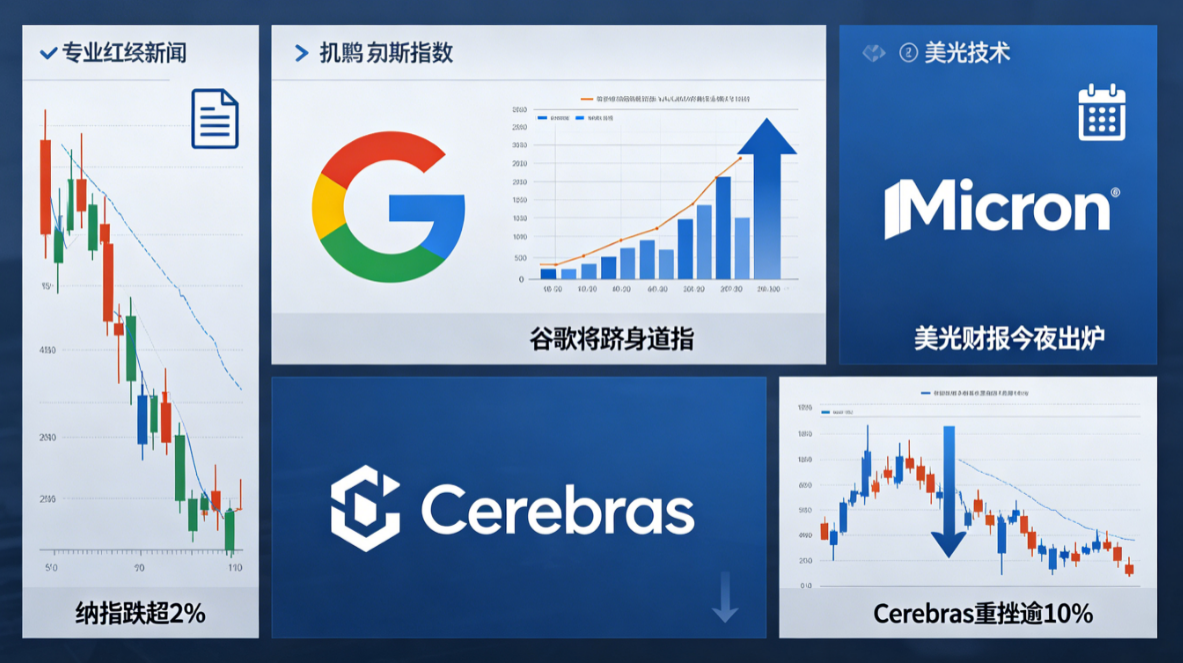
Tech Selloff Deepens as Storage Stocks Get Hit; Nasdaq Slides More Than 2%
Keywords: US stocks, Nasdaq, storage stocks, Micron, Google, Dow Jones, Cerebras, semiconductor sector, European markets, gold, oil
Introduction
Wall Street spent the session in a decidedly defensive mood on June 23, and the mood was especially rough for anything tied to semiconductors, storage, and high-growth tech. By the close, the Dow Jones Industrial Average barely budged, but the S&P 500 and especially the Nasdaq Composite were under heavy pressure, dragged down by a broad selloff in chipmakers and memory-related names.
What made the decline feel more uncomfortable than a routine dip was its breadth within tech. This was not just one superstar stock wobbling. From Arm and Qualcomm to Nvidia and AMD, the red ink spread across the sector. Even more striking, storage names were hit hard, with Micron and SanDisk both falling more than 13%. In other words, the market was not simply rotating out of one corner of tech — it looked like investors were suddenly questioning the strength of the entire hardware complex.
At the same time, the market got a dose of headline intrigue: Google is set to join the Dow Jones index, Micron’s earnings are due tonight, and Cerebras, often described as an “Nvidia challenger,” plunged after earnings. Put all that together, and you get a market day that felt less like a calm summer session and more like a reality check.
Nasdaq Takes the Brunt of the Pain
The headline numbers tell the story clearly enough. On June 23, the three major US stock indexes all ended lower:
- Dow Jones Industrial Average: down 45.87 points, or 0.09%, to 51,666.84
- S&P 500: down 107.33 points, or 1.44%, to 7,365.46
- Nasdaq Composite: down 579.56 points, or 2.21%, to 25,587.04
The Dow’s tiny decline suggests that the market was not in a panic across the board. Rather, the weakness was concentrated in the parts of the market that have led so much of the rally over the past year: technology, semiconductors, and AI-related infrastructure.
That’s why the Nasdaq looked so much worse than the Dow. The index is more heavily weighted toward high-growth tech names, and when those names start getting hit at the same time, the downside can snowball quickly. Investors who had grown used to buying every dip in the AI trade suddenly had to deal with a much less forgiving tape.
Semiconductors Turn from Star to Stress Point
The hardest-hit area of the market was the semiconductor group, which had been one of the market’s biggest winners. This time, the chip trade was all about selling first and asking questions later.
Among the biggest losers:
- Arm fell more than 10%
- Qualcomm dropped more than 8%
- Taiwan Semiconductor and Intel lost more than 6%
- Tesla, AMD, and Oracle fell more than 5%
- Nvidia declined more than 4%
- Broadcom slipped more than 3%
- Apple fell nearly 1%
- Microsoft managed to rise more than 1%
This kind of move matters because semiconductors are no longer just a niche corner of tech. They have become the backbone of the entire AI narrative. If chips are in trouble, then the market’s most important growth story starts to look a little less bulletproof.
One possible takeaway is that investors are becoming more selective. A lot of money has flowed into anything related to AI, data centers, and advanced computing. But when valuations get stretched, even a modest shift in sentiment can trigger a sharp reset. That does not necessarily mean the long-term story is broken. It does mean the market may be demanding more proof and less hype.
Storage Stocks Get Crushed
If semiconductors had a bad day, storage stocks had a brutal one.
The storage group — especially memory names — was one of the most alarming weak spots in the session:
- Micron Technology fell more than 13%
- SanDisk dropped more than 13%
- Western Digital lost more than 8%
- Seagate Technology declined more than 5%
This was the kind of move that makes traders sit up and check whether they missed an earnings warning, a demand reset, or a pricing signal from the industry. When memory and storage stocks all sell off together, the market is usually trying to tell us something about the outlook for data center demand, pricing power, or inventory conditions.
The phrase “small note brings down storage” captures the mood pretty well: sometimes, the market does not need a huge macro shock to turn bearish on a group. A single cautious read on demand or margins can be enough to flip sentiment, especially after a strong run.
The storage business has always been cyclical, but it is now even more sensitive because it sits close to the AI buildout. Data centers need huge amounts of storage, and investors have been eager to assume that this wave of infrastructure spending will stay strong indefinitely. Monday’s action suggests that some traders are starting to question whether that optimism has gone too far, too fast.
Why this matters
Storage names often act as a kind of temperature gauge for the broader tech cycle. If the market starts to believe that enterprise spending is slowing, or that hyperscalers are getting more cautious with capital expenditure, then storage stocks tend to react quickly. That’s because their earnings can swing sharply with demand and pricing trends.
So while the drop may look dramatic on the surface, it also tells us something deeper: investors are getting more nervous about the second-order effects of the AI boom. Everyone loves the headline names, but the supply chain beneath them can be far more fragile.
Optical Communication Stocks Also Get Caught in the Sweep
Another weak pocket was the optical communication group, which has become increasingly important in the AI era because large data centers depend on faster, denser, and more efficient networking.
On the day:
- Applied Optoelectronics fell nearly 14%
- Credo Technology and Coherent lost more than 10%
- Corning and Lumentum fell more than 7%
This sector has benefited from the same AI infrastructure story that powered semis and storage. If more data centers are being built, then more optics, connectivity, and fiber-related equipment are needed. But once again, the market is reminding everyone that even a promising long-term theme can get hit hard when expectations get ahead of reality.
The broader message here is simple: investors are no longer rewarding every AI-adjacent name just because it has “data center” in the business description. The market wants clarity on revenue growth, margin stability, and real customer demand.
Google’s Dow Move: Symbolic, But Still Important
One of the more interesting headlines was that Google will join the Dow Jones Industrial Average. While this move does not directly change the fundamentals of the company, it matters in a symbolic and mechanical sense.
For one thing, the Dow remains one of the most watched stock indexes in the world. Inclusion gives the stock a more prominent place in the public market conversation. It also means that index funds tracking the Dow will need to own the shares, which can create steady demand.
But the broader meaning is even more interesting: Google’s addition highlights just how dominant mega-cap tech has become in the modern market structure. Companies that once felt like disruptive outsiders are now market pillars. That tells you how much the economy, investor sentiment, and index composition have changed over the past decade.
Still, being added to the Dow does not guarantee smooth trading. In fact, the market often uses such news as a chance to rebalance and rotate, especially if broader sentiment is already weak.
Cerebras Slides After Earnings
Another name drawing attention was Cerebras, often described as an “Nvidia challenger,” which dropped more than 10% after earnings.
That move is worth watching not because one company’s stock necessarily changes the whole AI landscape, but because it reflects how demanding the market has become. Investors no longer want a good story. They want accelerating revenue, sustainable margins, and a believable path to scale.
For smaller AI hardware players, that can be a high bar. If results disappoint even a little, the stock can get punished aggressively. And when those stocks are already priced for perfection, the reaction can be swift.
Cerebras’ post-earnings drop is another sign that the AI trade is entering a more mature — and less forgiving — phase. The market is starting to distinguish between companies that can truly monetize AI demand and those that simply sound exciting.
Chinese ADRs and Europe Also Lost Ground
The weakness was not limited to US tech.
Among popular Chinese ADRs, most names fell, although the Nasdaq Golden Dragon China Index only slipped 0.55%. Individual moves included:
- JD.com and Xunlei down more than 3%
- Alibaba down more than 2%
- NetEase and PDD Holdings down nearly 2%
- Baidu down more than 1%
The move was not as dramatic as in the US chip space, but it still pointed to a generally cautious tone toward risk assets.
In Europe, the picture was also red:
- FTSE 100 down 0.09%
- CAC 40 down 0.71%
- DAX down 0.98%
European markets were weaker, but not in panic mode. The losses looked more like a continuation of global risk aversion than a standalone local story.
Commodities Fell Too, with Metals Leading the Drop
It was not just stocks that felt the pressure. Oil and especially precious metals also moved lower.
By the close:
- WTI crude oil fell 1.10% to $73.05 per barrel
- Gold futures dropped 1.75% to $4,129.0 per ounce
- Silver futures sank 6.03% to $61.63 per ounce
- Spot gold fell 1.94% to $4,110.11 per ounce
- Spot silver plunged 5.41% to $61.59 per ounce
The sharp fall in silver stands out in particular. Silver often behaves like a hybrid between a precious metal and an industrial commodity, so a move like this can reflect both risk-off sentiment and concerns about broader demand. Gold’s drop is also a reminder that even traditional safe havens can get sold when investors rush to raise cash or de-risk portfolios.
Oil’s decline was milder, but it still fit the general picture: markets were in no mood to chase cyclical assets.
What Investors Should Watch Next
Looking ahead, the most important question is whether Monday’s selloff was just a one-day reset or the beginning of a more meaningful rotation.
A few things are worth monitoring:
-
Micron’s earnings report
Since memory stocks were hit hard ahead of the release, tonight’s report could either confirm the market’s fears or restore confidence. If guidance is strong, some of the damage may be reversed. If not, the selloff could deepen. -
Semiconductor sentiment
If selling continues in the chip space, that would suggest investors are reassessing the entire AI capex cycle, not just one or two names. -
Leadership concentration in tech
The market has leaned heavily on a small set of mega-cap winners. Whenever those names stumble together, the broader index can look far more fragile than headline earnings growth would suggest. -
Risk appetite across assets
Weakness in commodities, European equities, and Chinese ADRs suggests the move was part of a wider caution wave, not just a US-only issue.
Conclusion
Monday’s session was a good reminder that even the strongest market themes can cool off fast. The Nasdaq’s 2.21% drop was driven mainly by a sharp pullback in semiconductors, memory, and optical networking stocks — the very groups that have benefited most from the AI boom. When Arm, Qualcomm, Nvidia, Micron, and SanDisk all slide at once, it tells you the market is doing more than taking profits. It is rethinking assumptions.
That doesn’t mean the long-term tech story is over. Far from it. AI infrastructure, cloud computing, and advanced chips are still central to the investment landscape. But it does mean investors may need to get used to a market that is less willing to pay any price for growth.
In short: the rally is not dead, but the easy part may be behind us. And for a market that has been powered by enthusiasm, that is a notable shift.